
MES
Economic production quantity: why ERP overproduces and ties up cash
29 de October de 2026
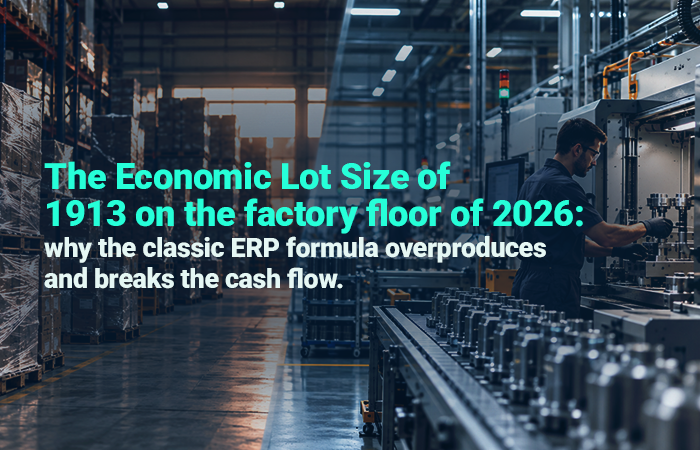
The 1913 economic lot on the 2026 shop floor: why the ERP's classic formula overproduces and breaks cash flow
In industrial production planning, few mathematical formulations have achieved such longevity as the Economic Production Quantity (EPQ), derived from the classic Economic Order Quantity (EOQ) formula developed by Ford Whitman Harris in 1913.
For more than a century, this model has been the mathematical foundation used by ERP (Enterprise Resource Planning) systems and by production planning and control (PPC) modules to define the "optimal" size of manufacturing orders.
The logic of the equation is elegant in theory: to find the exact balance point between line preparation cost (setup) and inventory carrying cost (holding cost). If a tool changeover on a machine is slow and expensive, the formula dictates that the plant must run enormous lots in order to "dilute" the fixed preparation cost across the largest possible number of units produced.
Yet in the real dynamics of today's markets — shaped by high demand volatility, shortened delivery times, proliferation of SKUs (stock-keeping units), and liquidity constraints — blind reliance on this century-old equation has become a financial trap.
The lot the ERP calculates as "economically optimal" under office parameters is frequently the same lot that swells finished-goods warehouses with non-moving items, consumes the company's working capital, and paralyzes the plant's commercial responsiveness.
The problem is not Harris's mathematics itself, but the chronic disconnect between the static parameters registered in the corporate software and the physical, dynamic reality of the shop floor. By treating setups as immutable constants and inventory carrying costs as abstract annual percentages, the ERP's Economic Lot forces systematic overproduction, strangles cash flow, and sabotages the profitability it promised to protect.
1. The illusion of cost dilution: efficiency on paper versus strangled cash flow
The greatest stimulus to overproduction arises from the accounting incentive the classic formula provides. When engineering registers in the system that the setup of a given line lasts 4 hours and costs R$ 12,000 in labor and idle machine time, the ERP optimization algorithm inevitably calculates orders for 50,000 or 100,000 units.
In the view of traditional controllership and the plant committee, the decision looks brilliant:
The unit cost absorbed per piece produced falls by centavos in cost accounting.
The line-efficiency indicator shows high figures, because the equipment ran for weeks without interruptions for adjustments.
PPC presents reports with theoretical capacity fully utilized.
But the financial laws of the real world present the bill as soon as the order ends. The plant produced for inventory, not for orders on the books. Because actual customer demand was only 15,000 units for that month, the other 35,000 pieces instantly become working capital immobilized in pallet-racking positions.
The paradox of the giant lot then sets in:
The product sits in the warehouse, consuming insurance, climate control, physical space, and the ongoing risk of damage or commercial obsolescence.
The money the treasury needed to buy critical raw materials or meet operating commitments was frozen in cardboard boxes at the distribution center.
Worse still: while the main line spent two weeks monopolized to manufacture this monster lot, dozens of other SKUs with firm customer orders went into critical delivery delay at dispatch because "the line could not be stopped, or the setup would be lost."
The company won a fictitious accounting victory on unit cost and reaped a tangible hole in liquidity and a loss of customers.
2. The blindness of the ERP's static parameters
Why does the ERP so often get the lot-size recommendation wrong? Because corporate management systems were designed to manage financial transactions, not to measure shop-floor physics in real time.
The classic lot calculation in the ERP suffers from three premises wholly disconnected from operational reality:
Setup cost and time treated as constants set in stone
In the corporate system's engineering master data, the setup of a given line has been fixed at 180 minutes since the last time-and-methods review, carried out two years ago.
In shop-floor practice, that time swings sharply: it varies with the skill of the shift crew, the temperature of the machinery, the die that has just been dismounted, and the chronological sequence of products (the transition from a light color to a dark one takes 40 minutes, while the reverse path takes 200 minutes). The ERP ignores the setup transition matrix and calculates the lot on a blind average.
Inventory carrying cost as a generic financial percentage
The inventory carrying rate (holding cost) is usually entered in the formula as a static accounting rate of 15% or 20% per year. That simplification ignores that the cost of carrying inventory varies dynamically with the base interest rate (the opportunity cost of working capital), the physical saturation of the warehouse, and the intrinsic perishability of the SKU. In periods of expensive capital and tight credit, holding idle product costs far more than the ERP formula assumes.
Ignorance of bottleneck constraints and in-process buffers
The 1913 equation calculates the lot of a resource as if it operated in a vacuum. It does not see whether the subsequent resource (downstream, such as secondary packaging or quality inspection) has the capacity to absorb that torrential volume. The result is the uncontrolled buildup of work-in-process inventory (WIP — Work in Process) occupying the aisles of the plant warehouse, blocking physical circulation, and creating operational confusion.
3. From the Rigid Lot to the Dynamic Lot: the MES layer's response
Breaking with the oversized-lot trap does not mean abandoning planning, but feeding planning with live execution data. The shift from bureaucratic rigidity to profitable flexibility happens when the plant replaces theoretical parameters with the operational intelligence of the MES (Manufacturing Execution System) layer.
By connecting line execution directly to the scheduling layer, order sizing evolves along four fundamental dimensions:
Real-time measurement of actual setup time and cost
The MES does not accept registered averages. It captures the exact timestamp from the completion of the last good piece of the previous lot to the formal release of the first conforming piece of the new lot.
The system isolates internal and external preparation steps, measures adherence to SMED (Single-Minute Exchange of Die) practices, and continuously updates the dynamic setup matrix by SKU pair. If the team reduced changeover time from 180 to 45 minutes through process improvements, the system immediately reflects that achievement in the preparation cost.
Intentional reduction of the viable lot (lean lot sizes without margin loss)
By exposing the real reduction in setup time, the mathematical barrier to running smaller lots disappears. The plant starts to produce, safely, lots strictly matched to market pull demand, without the artificial need to overproduce in order to dilute fixed costs.
The plant's total cycle time (lead time) collapses, the need for safety stock declines, and working capital is released for strategic investments.
Intelligent sequencing by attribute-affinity matrix
The advanced scheduling engine coupled to the MES does not schedule orders by order of arrival in the ERP. It cross-references sales orders with the real matrix of machine cleaning and adjustment effort (grouping by coil width, chemical family, density, or color tone).
Sequencing minimizes the need for deep cleaning and complex tooling changeovers, making rapid, frequent changeovers between different products feasible within the same shift.
Accounting close of transition cost by production order
The direct-labor cost spent on preparation, the pieces scrapped during the adjustment ramp-up, and utility consumption during setup are allocated with surgical precision to the executed order. Controllership comes to see whether a given product changeover was economically advantageous or consumed the margin of that specific lot, eliminating generic allocations.
4. The impact on the income statement (P&L) and the balance sheet: agility that protects cash
Modernizing lot sizing through the MES transforms the relationship between the plant and finance leadership:
Direct recovery of working capital: a 25% to 40% reduction in the volume of idle finished-goods inventory sitting in warehouses, reducing dependence on bank credit lines and inventory financing.
Drastic reduction in manufacturing lead time: the interval between the commercial order entering the system and the delivery truck leaving falls from weeks to days, increasing sales competitiveness.
Elimination of losses from obsolescence and expiry: producing smaller, frequent lots reduces to zero the risk of discarding entire pallets of products that have lost commercial validity on the shelves.
Maximum adherence to the commercial plan: line flexibility makes it possible to respond to seasonal fluctuations and urgent customer orders without creating chaotic misalignment in the other production orders.
Conclusion: the ideal lot is the one that balances demand, cost, and liquidity
The Economic Lot formula was a fundamental milestone in the history of production engineering, but using it in 2026 with static records in spreadsheets or blind ERP modules is to govern 21st-century industry with conceptual tools from the First World War.
In the contemporary industrial environment, flexibility is not a concession to operations; it is the primary lever of cash preservation. When the plant replaces the dogma of the long production run with real-time control of setup times and dynamic sequencing via MES, it stops stocking inefficiency and delivers commercial agility and consistent profitability.
Achieve flexibility and protect your working capital with PlantSuite
Is your plant still overproducing enormous lots on the shop floor only to dilute setup costs registered in the ERP?
The PlantSuite MES platform offers advanced modules of Production Scheduling, Efficiency, and real-time integration with ERP systems via the ISA-95 standard. Measure the real cost of line preparation, implement dynamic sequencing by attribute matrix, and reduce your inventories without sacrificing the productivity of your industrial assets.
👉 Talk to the PlantSuite specialists and discover how to align the pace of your production with the speed of the market.
Notícias relacionadas
How Weighing MES Improves Compliance
27 de October de 2026

The myth of the heating curve: why waste 4 hours every week?
21 de October de 2026
Manipulating the OEE to 90% is the fraud that hides the margin
15 de October de 2026

Manipulating the OEE to 90% is the fraud that hides the margin
7 de October de 2026