Blog
The myth of the heating curve: why waste 4 hours every week?
21 de October de 2026
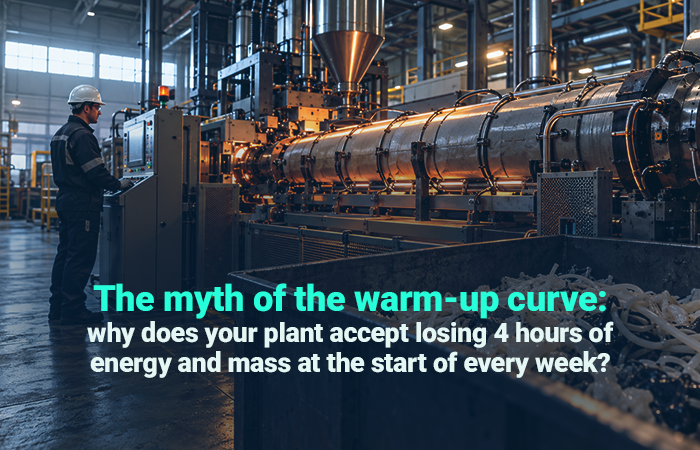
In the first hours of every Monday —or after any prolonged maintenance shutdown— industrial halls running thermal and continuous processes repeat a silent and costly ritual.
Melting furnaces, polymer extruders, chemical reactors, drying tunnels and hot-fill packaging lines are energized long before the production team arrives.
Chimneys begin to smoke, electric heaters run at full power, steam boilers burn fuel and compressors reach full load.
When the first shift finally takes their stations, the physical process is still not ready to run: operators start dosing raw material only to generate tons of “purge,” carbonized polymer masses, deformed bottles or formulations outside viscosity that are immediately discarded into bins.
This transition period —which consumes two to five hours per line— is routinely justified under the technical claim of the “inevitable heating curve.”
For finance and operations management, however, this normalization conceals one of the largest cash drains in modern manufacturing: the invisible cost of uncontrolled startup.
When asset startup depends on the empirical judgment of each shift, the plant burns thousands of kilowatt-hours, consumes high-value materials at scrap prices and destroys the contribution margin of the week’s first batches before a single conforming part is shipped.
1. The anatomy of startup loss: where does the money go?
The cost of bringing a thermal line to steady-state regime is rarely measured separately in traditional ERP cost centers. Instead, the expense is diluted into generic “plant utilities” accounts or absorbed into the month’s average margin.
When we break down the hours preceding nominal production, three financial drains act simultaneously:
Peak demand and empty utilities consumption
To overcome the thermal inertia of cold equipment, control systems demand peak power. If pre-heating is started too early —because the previous shift decided to “make sure it was hot”— the line consumes natural gas, steam and electricity for hours without producing a single saleable unit.
If three large lines enter their thermal ramp at the same time, the plant also risks exceeding contracted electrical demand and paying punitive tariffs to the utility.
The purge bin and raw material degradation
In plastic, rubber, ceramic or non-ferrous casting processes, material that sits stationary in barrels and dies during the thermal ramp degrades from excessive residence time. Polymers oxidize, compounds burn and thermal additives lose their functional properties.
The result is hundreds of kilograms of premium resin discarded as scrap or reprocessed with severe loss of mechanical properties.
Under-speed and hysteresis of the first batches
Even after the panel temperature reading reaches the nominal value, tools, barrels and molds have not yet achieved homogeneous structural thermal equilibrium (dynamic thermal equilibrium).
Forcing early production generates parts with dimensional defects, warpage or out-of-spec thickness. The operation responds by reducing nominal speed 30–40 % to “compensate for instability,” raising direct labor cost per part.
2. Why manual procedure fails at startup
If startup parameters are written in process sheets and Standard Operating Procedures (SOPs), why is the startup ramp still so volatile?
The failure stems from dependence on uncoordinated manual interventions:
- Startups based on operator intuition: the senior operator on Shift A turns on heating zones three hours early because “the old machine takes time to heat up.” The Shift B operator turns them on one hour early at excessive power, causing thermal shock to heating elements and localized barrel overheating. There is no mathematical repeatability.
- Premature raw-material feeding: pressure to hit the shift’s volume target leads operators to fill hoppers and reactors before the mold and die reach homogeneous working temperature. Raw material passes through cold zones, causing blockages, abrasive wear on screws and emergency stops.
- The lie of the surface thermocouple: many analog machines display the heater temperature, not the melt or tool-core temperature. The panel shows 210 °C while the steel core of the mold is still at 140 °C. The operator sees a green screen; the physical process delivers guaranteed scrap.
3. From uncontrolled inertia to automated ramp: the MES approach
Containing startup cost requires removing ramp control from visual judgment and embedding it in a procedural automation flow governed by the MES (Manufacturing Execution System) layer.
By synchronizing digital recipe execution with real-time telemetry from Programmable Logic Controllers (PLCs), plant startup ceases to be a gamble and becomes a rigorous mathematical protocol:
- Staged and timed pre-heating ramp
The MES integrates with order scheduling and the utilities system. Based on the Production Order scheduled to start at 06:00, the system automatically activates the thermal relays of the heating zones at the exact calculated minute so that melt temperature is reached ten minutes before the crew takes the line —not one second earlier, not one second later. - Process interlock logic
The MES recipe execution engine acts as an unbreakable digital gatekeeper: until all melt-temperature and line-pressure sensors are inside the tolerance band defined in the master recipe (compliant with ISA-88), the system physically blocks the main extruder motor or the opening of dosing valves. It is impossible for the operator to introduce raw material prematurely and generate purge through error. - Intelligent peak-utilities demand management
In plants with multiple furnaces or reactors, the control layer coordinates ramp starts in cascade. The MES prevents five pieces of equipment from beginning their highest-power curves simultaneously, flattening the plant’s electrical demand curve and keeping thermal consumption strictly inside the economical contracted band. - Accounting isolation of startup costs by batch
Every kilowatt-hour, cubic meter of gas and kilogram of scrap consumed during the initialization period is tracked under the classification “state-transition cost.” This value is not hidden in the overall batch cost: it appears clearly on the line’s P&L, allowing process engineering to calculate exactly the real cost of each weekend shutdown versus the viability of continuous shifts.
4. The P&L gain: energy saved, scrap stopped and capacity released
Standardizing and automating the heating curve on the shop floor delivers direct and immediate financial impact to controllership and manufacturing leadership:
- Direct savings of 10–25 % on the utilities bill: by eliminating furnace and heater runtime in empty mode before the real shift begins.
- Drastic reduction of start-of-shift scrap: more than 70 % reduction in purge losses and non-conforming product generated while trying to stabilize the machine by trial and error.
- Generation of hidden productive capacity: converting 4 hours of disorderly heating into 90 minutes of automated ramp returns 2.5 full-revenue hours per week to the line, unlocking installed capacity without investment in new machines.
- Extended tooling life: controlled, gradual thermal ramps reduce mechanical fatigue from thermal shock in heaters, screws, molds and furnace refractories, lengthening preventive-maintenance intervals.
Conclusion: a stable thermal process is a timed process
Material thermal inertia is an inflexible law of physics, but uncontrolled waste at line startup is a management choice. Treating the heating curve as an empirical mystery that requires sacrificing energy and raw material every week is to tolerate the deliberate burning of net margin.
Modern industry cannot allow million-dollar furnaces and machines to operate according to each operator’s habit. When the plant anchors its startup routine in real-time telemetry, locked digital recipes and automated ramp control via MES, physical process stability translates directly into cost predictability and protected cash.
Eliminate energy and raw-material waste at startup with PlantSuite
Is your plant still losing precious production hours and burning utilities every Monday trying to stabilize thermal lines?
The PlantSuite MES platform provides advanced execution control with the IoT Data Hub, Recipe Management (ISA-88) and Production Tracking modules. Automate thermal ramps, lock raw-material feed until parameters are truly stable, and turn initialization losses into billable productive capacity.
👉 Talk to the PlantSuite specialists and discover how to place the physics of your thermal process under rigorous digital control.
Notícias relacionadas